The last two and a half weeks have been... well, a blur. Days turned into nights, weekends melted into midweek, and the line between "personal life" and "work" was almost completely erased. There are projects you manage, and there are projects you live and breathe.
Working on the "How Are You?" campaign for the Ikar nonprofit was the second kind. It wasn't just another marketing "brief". It was an emergency mission: to make critical professional knowledge about mental health accessible, in real time, to a society in acute distress.
Now, with the campaign live and me managing to take half a deep breath, I want to share a few insights from the other side of the screen: about the challenge of translating clinical terms into everyday language, and about what it means to make information accessible when the public system can't handle the load.
The double challenge: a system collapsing, a public in denial
The starting point of this campaign was a hard, complex Israeli reality, made up of two problems that collide with each other:
- The treatment vacuum: the public mental health system is collapsing. Waiting lists for psychologists or psychiatrists can take half a year and even more. People who need help now are left with no answer.
- Blindness to the problem: at the same time, a huge part of the population in Israel isn't even aware that they're dealing with symptoms of trauma. People keep functioning on "autopilot", push things down, and tell themselves "everything's fine", while untreated trauma can easily turn into chronic post-traumatic stress (PTSD).
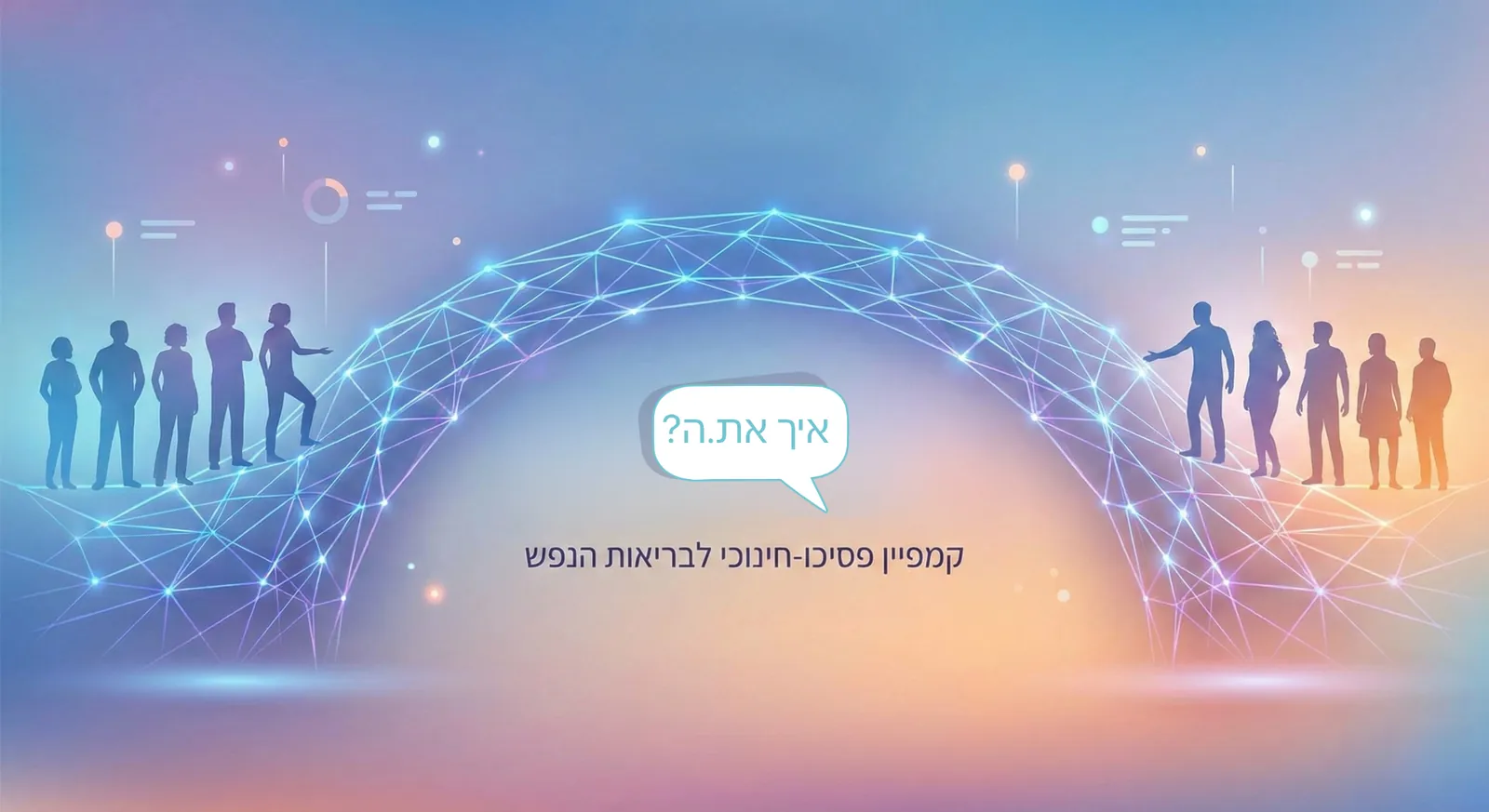
Our brief was to bridge this impossible gap. To create a psychoeducational campaign that gives a first, immediate and accessible response, both to people waiting in line for treatment, and also (mainly) to people who don't even know they need it.
The work: translating the DSM into human language
Working on this project demanded that we, as strategy and marketing people, learn a new language. We had to take complex clinical knowledge about trauma mechanisms, resilience and emotional regulation, and translate it into simple tools, at eye level, that anyone can understand and use, without cheapening the professional content and without falling into clichés.
It was a sprint of precision. Every word was weighed. Every visual was examined not only through the lens of "is it creative?", but through the lens of "is it responsible? Is it clinically accurate? Could it be triggering?".
The understanding that we weren't just "selling a product", but giving psychological first aid to thousands of people, was the engine behind every sleepless night and every endless round of revisions.
The main insight: knowledge is (healing) power
The strongest thing I took from these two and a half weeks is the huge power of normalizing. The campaign website (hru.org.il) isn't just an information hub; it's a mirror. It lets people read about symptoms they're experiencing, and understand that they're not crazy, they're not "broken", and they're not alone. Their reactions are normal reactions to an abnormal reality.
Being able to put a name to a feeling, to understand the physiological mechanism behind anxiety, and to learn one simple tool for self-regulation, is sometimes all a person needs so they don't go under. It's the difference between trauma that sets in and the beginning of healing.
Coming full circle: from Crohn's to the mind
For me, this project is much more than another professional task. It's coming full circle. The challenge of taking complex medical information, the kind written in "doctorese" that only experts understand, and making it accessible to ordinary people in distress, isn't new to me.
I started doing it years ago, when I was diagnosed with Crohn's. I found myself facing a medical system that might as well have been speaking Greek, and I realized that if I wanted to survive and manage my illness, I had to translate that information for myself. I started making that knowledge accessible as a public service, entirely as a volunteer, simply because I realized how much anxiety a lack of knowledge creates.
This campaign felt like the crunch time of that journey. All the experience I'd built making information accessible in the world of physical health came together in this moment, when I had to do exactly the same thing, but big, for the mind of a whole country.
Summing up
I'm coming out of this intense period with a sense of mission. It's a huge privilege to use our professional tools, strategy, creative, digital, to make knowledge accessible that can truly save lives, or at least significantly improve the quality of life of so many people who fall through the cracks.
I invite you to visit the campaign website, not only as professionals interested in the campaign, but as human beings living in the Israeli reality. Check in on how you are, really. The information there is for all of us.
To the campaign website: hru.org.il