
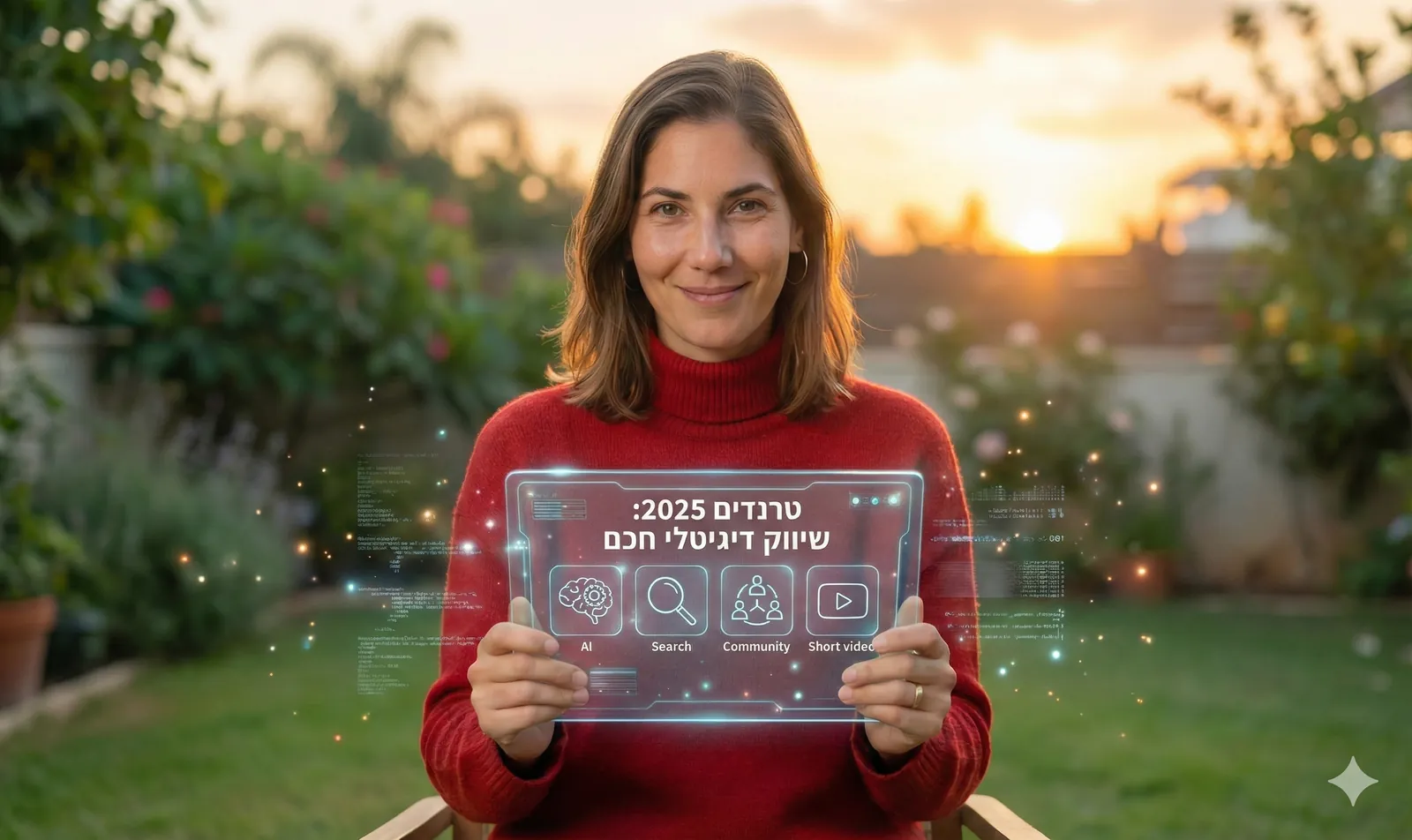
If there's one thing we've learned in the last two years, it's that the pace only keeps speeding up. Marketing trends used to last two or three years. Today it seems like every week there's a new tool that "changes everything", a new platform everyone flocks to, or an algorithm update that turns everything we knew upside down.
For freelancers and business owners, this can be exhausting. That feeling that you're always chasing, always one step behind, isn't pleasant. But right before 2025 walks in the door, I want to offer you a different angle. Instead of trying to catch every little wave and run after all the hype, let's look at the deep currents. At the fundamental changes that will really affect how we do business in the coming years.
I analyzed what's happening in the field, and found four main directions that will be with us in the coming year. The good news? They all lead, in the end, to marketing that's more precise, more personal and quieter.
1. AI grows up: from a toy to a core work tool
If 2023 and 2024 were the years of "wow, look what this bot can do", 2025 will be the year of "okay, practically, how does this make my business run better". We're moving from the excitement (and fear) stage to the implementation stage. AI stops being "that cool thing on the side I play with when I have time", and becomes an inseparable part of everyday work processes, like your email or your calendar.
What does that mean in practice? We'll see less generic, shallow content made with "copy-paste" from ChatGPT, and more smart use of AI as a strategic support engine: for analyzing client data, for real personalization of messages (and not just "Hi [name]"), for complex automations that save hours of work, and for creative brainstorming. Whoever knows how to "talk" to the machine (write precise prompts) will have a huge advantage.
So what do you actually do with this? Stop looking for the "magic button" that does everything for you. Start bringing AI tools into the specific tasks that eat up your time and energy: drafting emails, coming up with content ideas, summarizing long meetings, or building a work Gantt chart. The goal isn't to replace you, it's to give you back the time to be the manager.
2. Search based on answers (SGE), not links
Google is changing in front of our eyes. Instead of getting a list of 10 blue links when we ask a question, we're starting to get a direct answer, summarized and processed by AI, at the top of the page. What does that mean in practice? That our content strategy has to change. If the goal used to be "stuffing keywords" to show up in the first result, today the goal is to be the authoritative source the AI quotes its answer from. That means shallow content, copied content, or content that adds nothing new will simply disappear.
So what do you actually do with this? Focus on creating content that's deep, original, and gives real, unique value you can't find anywhere else. Share insights from your own experience, unique data you collected, or original points of view. Answer your clients' complex questions thoroughly, so Google sees you as the authority in your field.
3. The longing for micro-communities and radical authenticity
The more artificial and machine-made content becomes, the more real human connection is worth. People are tired of polished mega-influencers and audiences of millions. They're looking for the "small campfire", the place where you can take off the mask. What does that mean in practice? The shift will be to closed boutique communities: quiet, focused WhatsApp groups, private and intimate newsletters, or dedicated community platforms. The brands that succeed in 2025 will be the ones that know how to build a real, two-way relationship, not just broadcast messages to a wide audience.
So what do you actually do with this? Think about where your audience feels most comfortable, and build a direct line of communication there. It could be a personal weekly newsletter where you share what's really happening behind the scenes, or a WhatsApp group for VIP clients where you're available for questions. The focus is on the quality of the connection, not the number of followers.
4. Short video, but with meaning
TikTok and reels aren't going anywhere, but there's a shift there too. Audiences are starting to tire of "noise" content: trendy dances, lip-syncs, or shallow 7-second tips that don't really give value. What does that mean in practice? We'll see more short video that's "edutainment", but with a strong focus on real value. Fewer filters and big productions, more direct, authentic talking to the camera, and more ability to distill a complex idea or an important insight into one precise minute.
So what do you actually do with this? If you make videos, stop thinking about "going viral" and start thinking about "value". Take a common question from a client, and answer it as clearly and simply as you can in a one-minute video. Talk to the camera the way you talk to a friend. Authenticity will beat production.
The bottom line: technology will keep racing ahead in 2025 too, and that's okay. We don't need to run at its pace. Our job isn't to adopt every new tool that comes out. Our job is to stay true to our strategy and our values, and to use technology only where it serves them, helps us sharpen the message, and makes time for the thing that really matters: the human connection with our clients.