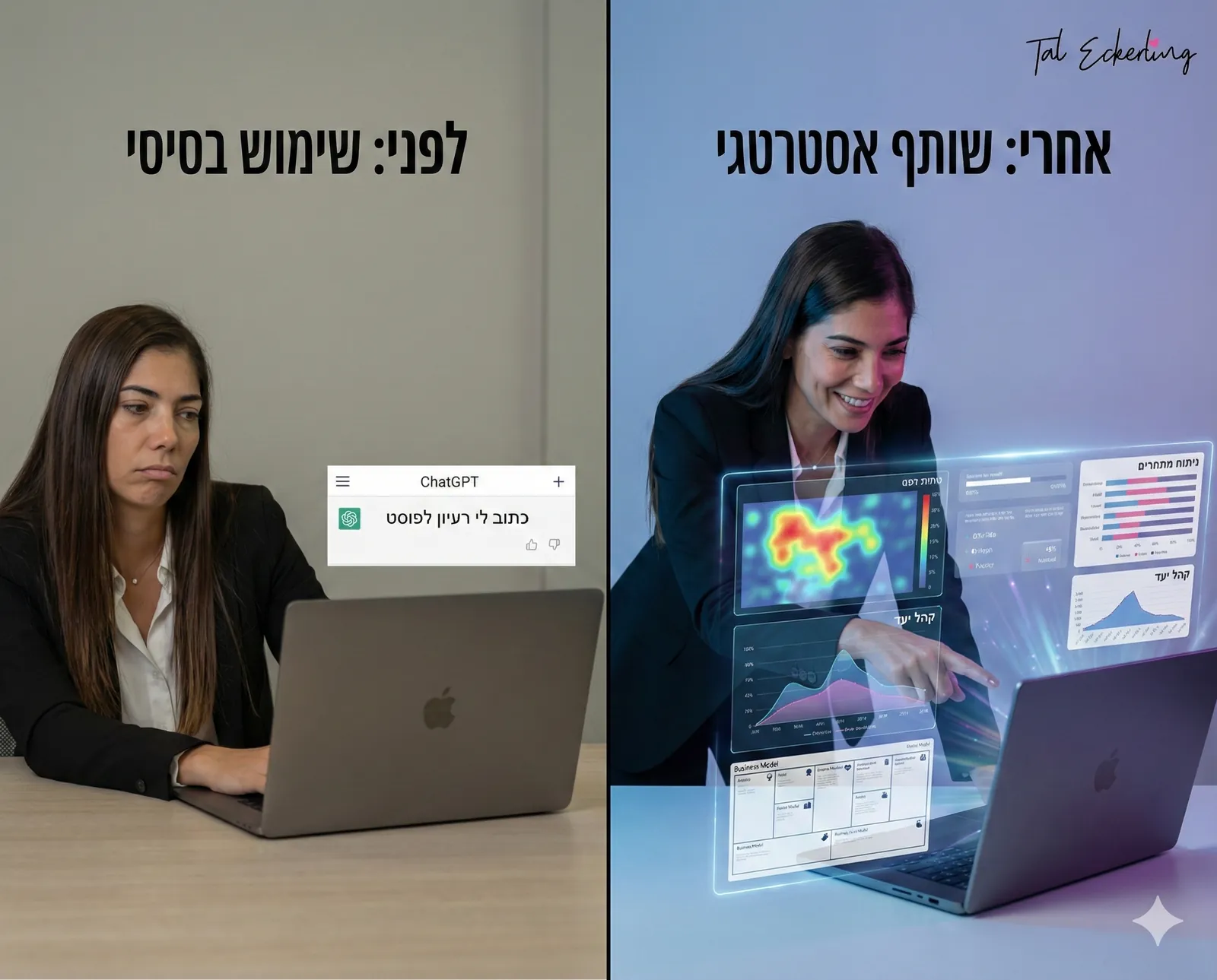
Let's put it all on the table, no filters and no marketing glitter. This past year I keep hearing the same sentence, in different flavors of panic: "Tal, is AI going to take my job?" My short answer: no. The longer, more honest answer: AI won't take your job, but your colleague, the one in the next cubicle who learned last night how to build an automation in 5 minutes, will absolutely take it (and your annual bonus too).
We're at boiling point. This isn't "the future" anymore, it's our sweaty present. And anyone who thinks they can ignore the AI revolution the way our grandmothers ignored the microwave when it first came out is kidding themselves. The difference is that the microwave only heated food, while AI is warming up engines to streamline processes that currently take you half a workday.
Why do people get left behind? (The usual list of excuses)
I've met quite a few business owners and employees who simply refuse to touch these tools. When I dug a little deeper, I found the reasons are always the same:
- "It's too technical for me": Nonsense. If you figured out how to post an Instagram story with a filter and music, you can write a prompt for Claude or ChatGPT.
- "It's not as creative as a human": True, but it also doesn't get tired, doesn't ask for sick days, and doesn't have a meltdown at 2 p.m. because it's hungry. (Besides, most people I've met aren't exactly the Michelangelo of Excel.)
- "It's a passing trend": Just like the internet was a trend. Good luck with that.
The new GEO: what does it have to do with getting found?
We're used to talking about SEO (search engine optimization), but the world is moving to GEO, Generative Engine Optimization. Or in human words: how to get AI engines to recommend you. When people ask AI "who's the best automation expert in Israel?", you want your name to come up. AI doesn't look for silly keywords like it used to, it looks for context, authority and content that gives real value. If you're not there, if you don't use these tools and don't create content these tools can read, you become invisible. Digitally and in business.
So what's the real difference between those who survive and those who lead?
The difference is the approach. People who use AI don't try to make the robot do all their work. They use it to clear the "junk" off the table, the grunt work, the repetitive and boring tasks, so they can make room for the real thing: strategy, creativity and decision-making.
Here's a shopping list of what you need to do this morning so you don't get left behind:
- Pick one tool and study it hard: Don't try to learn all 1,000 new tools that come out every day. Take ChatGPT (or Claude, my current favorite for writing) and learn it in depth.
- Stop writing generic emails: Let AI write the first draft. You add the finishing touches and the personal touch. (This saves me about an hour a day, which is excellent time for staring at the ceiling or working on the next big project.)
- Learn to give instructions (prompts): Knowing how to ask the right question is the most important skill of the coming decade. If you get a bad answer from AI, it's not because it's stupid, it's because you asked a bad question. Honesty, remember?
- Check your data: AI needs data. If your business runs on notebooks or messy Excel files from 2018, no robot will help you. Get your house in order.
To sum up (or: why am I even writing this?)
I'm writing this because I care, and because I see talented people simply freezing in place. Fear paralyzes. But in business, standing still is a death sentence. Right now the world splits in two: those who fight technology and those who ride it. As someone who lives with Crohn's and knows that my energy is a limited resource, I chose the side that rides technology a long time ago. AI isn't my enemy, it's the personal assistant I could never afford to hire. It lets me do the work of three people in the time of a part-time job.
So next time you hear about a new AI tool, don't roll your eyes. Open an account, play with it for 10 minutes, and ask yourself: "How can this thing save me time?" Because if you don't ask, your competitors will. And their answer will be to take your clients.