
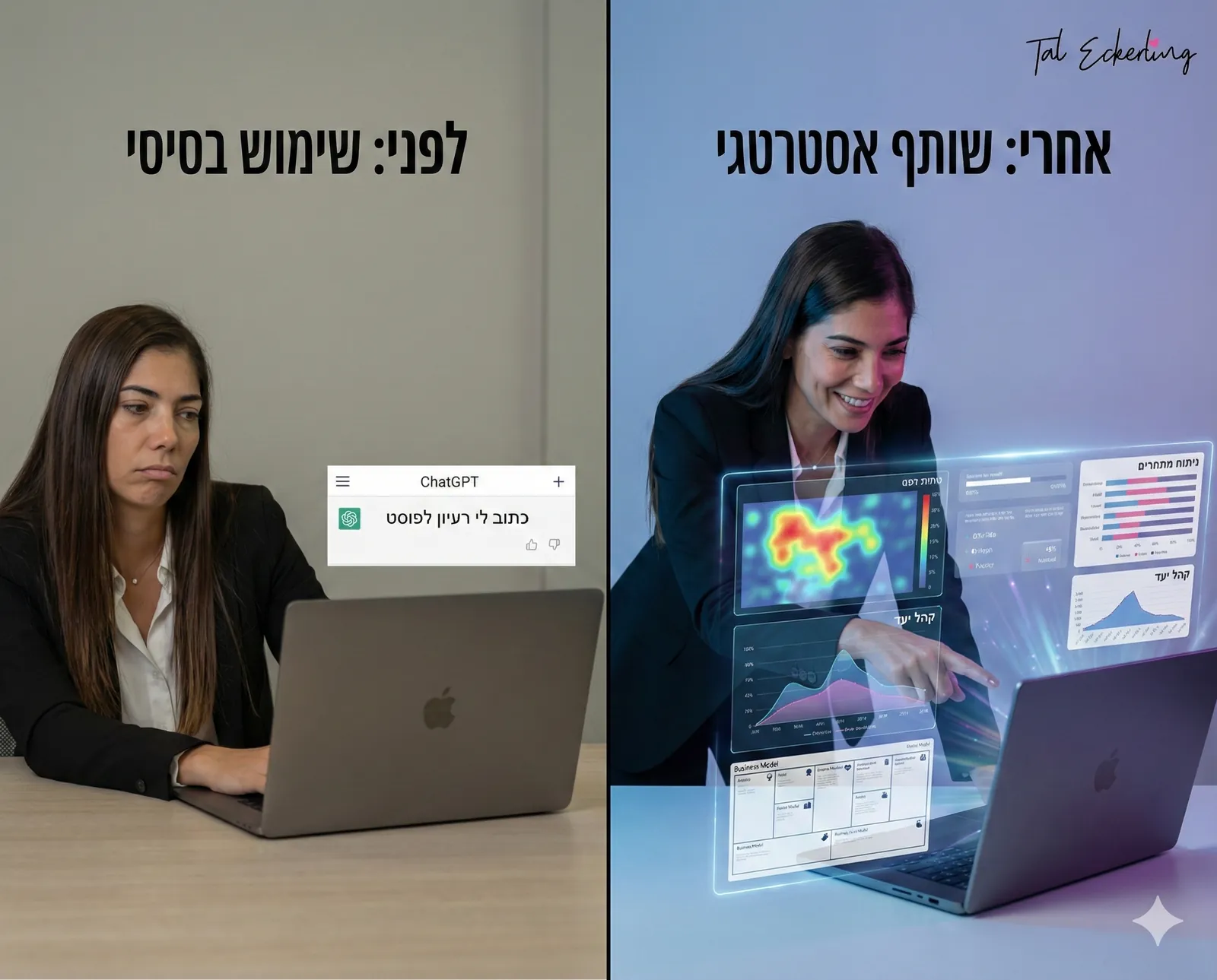
Let's be honest, the first excitement over ChatGPT and friends has calmed down a bit. Yes, it's still amazing. Yes, it saves time. We've all learned to ask it to "write 5 post ideas about time management" or "draft a polite email to a client who's late with a payment". And that's great. Really. It takes the weight of the "blank page" off us and helps us get through everyday tasks.
But every time I see a sharp, intelligent, ambitious business owner using AI only as a junior copywriter or an occasional secretary, my heart sinks a little. Why? Because it's like buying an advanced fighter jet and using it only to pop out to the corner store for milk. It works, you'll get there fast, but you've missed the whole point.
The real power of AI in 2025 isn't its ability to produce generic text quickly. Its real power is its ability to think, to analyze, and to act as a strategic partner at the highest level there is. A partner who has read the whole internet, knows complex business models, and never gets tired.
So how do you make that shift? How do you stop treating AI like a "junior" and start treating it like a board member? Here's the change in thinking you need to make, and three practical examples.
The change in approach: from "what" questions to "how" and "why" questions
The most common mistake I see is in the expectations. Most people come to AI with a "do it for me" attitude. Write it for me, make it for me, summarize it for me. That attitude turns you into a work foreman, and the AI into a worker on a production line.
To get strategic results, you need to come to it with a "let's think this through together" attitude. You're the CEO, and it's the senior advisor. You bring the vision, the values, the intimate knowledge of the business, and it brings the processing power, the data and the outside perspective.
Here are 3 ways to use AI as a strategic weapon that have nothing to do with writing posts:
1. Analyzing competitors and finding "blue oceans"
Instead of asking "who are my competitors in sleep consulting?", try something deeper. Feed the system text from your competitors' websites, or even better, reviews (good and bad) that their customers wrote about them on Google or Facebook.
The strategic prompt: "Read these 20 reviews written about my main competitor. Analyze them and find the pattern of repeated complaints. What deep need is this competitor failing to meet? Where is there a 'hole' in the market that I can step into with a better offer?" Suddenly, instead of a shopping list of competitors, you get a business insight worth its weight in gold: your chance to stand out.
2. Cracking your audience's psychology (far beyond demographics)
Knowing that your client is "35 to 45, lives in central Israel, self-employed" is nice, but it won't help you write a sales page that hits them in the gut. AI can help you get inside their head at a level no market survey can.
The strategic prompt: "I want you to step into the shoes of 'Dana', who runs a graphic design business and feels she works too hard and doesn't earn enough. It's 2 a.m. and she can't fall asleep. Describe her inner monologue. What is she really afraid of? What does she feel nobody understands about her? What's the secret dream she's embarrassed to say out loud?" The text you get back is pure raw material for building precise, empathetic marketing messages that meet your client exactly where they are.
3. A "red team" to test new ideas and services
Before you launch a new workshop, digital product or service package, you need someone to challenge you. Someone to look for the holes in the cheese. In the military and business worlds this is called a "Red Team": its job is to play the enemy, or the skeptic.
The strategic prompt: "I'm planning to launch a digital course on X at price Y. Here's the syllabus and the marketing promise. Now I want you to play the most skeptical, cynical customer there is. Why would she not buy this? What objections will come up for her? Be ruthless in your criticism so I can improve the offer before the launch." It's not an easy exercise for the ego, but it will save you a lot of heartache and help you build a bulletproof offer.
The bottom line: it's all about context The secret isn't one "magic prompt". The secret is giving the AI the full context. The more background you give it, the more constraints, and the more understanding of the big business goal, the smarter the results will be. Don't let it be just "the writer". Let it be your analyst, your psychologist, your quality critic and your advisor. It can do all of that, if only you ask it to.
Feel like you're using 10% of what these tools can do? The combination of precise business strategy and smart use of AI is the future. If you want to stop guessing and start building processes into your business that really move it forward, let's talk. Let's build your business's second brain together.