
An AI agent for business isn't a long prompt: it's a professional character with one specialty, its own working rules and access to your business profile, so it starts every task from what it already knows about you. A regular chat, on the other hand, starts every conversation from zero, and you explain again and again who you are, what the business does and what tone to write in.
You can see the difference in the work you get back. I build AI agents for businesses, and here's what's worth understanding before you choose.
What is an AI agent, in one sentence?
An AI agent is a language model, like Claude, that has been given a defined role, a working method and limits, plus access to the information it needs to do a specific professional task.
The difference between "AI" and "an agent" is like the difference between a talented person at a job interview and the same person a month into the role. Same talent, but now they know what's expected of them, how things are done in your business, and what's off limits.
How is an AI agent different from a chat?
| Regular chat | AI agent | |
|---|---|---|
| Context | You explain it again every conversation | Reads from a business profile that already exists |
| Specialty | The same Claude for everything | A specialist in one field, with its own rules |
| Method | Depends on what you wrote this time | Fixed, and repeats in every task |
| Limits | Whatever you remembered to ask for | Red lines defined in advance |
In practice: ask a chat to "write me a post about the new service" and you'll get a reasonable post that could fit any business. Ask the same of a marketing agent that knows your business profile, and it already knows who the audience is, what the prices are, how you talk, and what you never say.
What can AI agents do in a small business?
Almost anything a professional employee prepares for you before you approve it. To make it concrete, here's what each of the eight departments in my Full Office prepares:
- Marketing: a marketing plan, posts, emails, landing pages and ads.
- Branding: positioning, naming, tone of voice and visual identity.
- Sales: a sales call script, answers to objections and price quotes.
- Content: ideas, hooks and scripts for TikTok, Reels and YouTube.
- Strategy: a business model, pricing and a 90-day action plan.
- Operations: procedures, invoicing and collections, automations and order in your tasks.
- Podcast: concept, episode scripts, guests and distribution.
- Community: building a community, welcome messages and conversation that lasts.
You can ask the way you'd ask an employee:
"We're raising our prices next month. Prepare a message for our existing clients, and a short script for the call with anyone who rings to ask about it."
Why a team of agents and not one agent?
Because a business isn't one field. Whoever writes good posts isn't necessarily the one who builds the right price quote.
A team is several specialist agents with a manager who routes work to them. A pricing question goes to the pricing specialist, a post request goes to whoever writes posts, and you don't need to know whom to ask. And they all read from the same business profile, so the message stays consistent across departments.
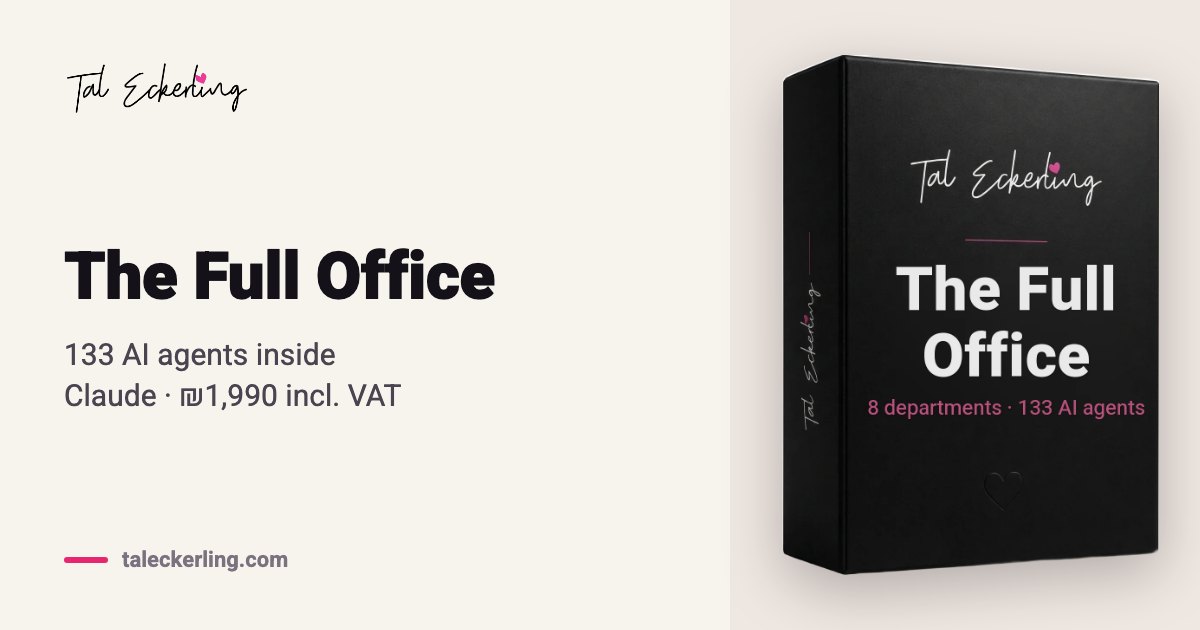
That's how the Full Office is built: 133 AI agents in 8 departments, one opening interview that builds the business profile, and an office manager who sends each request to the right department. Nicole Lieberman, co-founder of Female Film Club, described it like this (translated from Hebrew):
"And I feel like I have a huge team, 130 agents, each one in their own office, each one doing their own job, and they all talk to each other and support me." (the full video)
There's also another kind of team: a temporary one that Claude Code puts together for one big task and takes apart when it's done. Both kinds, and when each fits, are in the lesson Agent teams.
Does the language the agents were built in matter?
It does. My agents were built in Israel, in Hebrew, for small businesses, so they know things a translated tool misses: they write natural Hebrew for both genders, and they know Israeli VAT and a Sunday to Thursday work week.
They also work in English. Write to them in English and they answer in English, and in the opening interview you tell them who your audience is, so the messages fit.
What doesn't an AI agent do?
It's worth being honest here, because this is the part people tend to mix up.
- It doesn't publish or send anything for you. The agents write, build and advise. You do the publishing and the sending, so you stay in control.
- It doesn't replace your accountant or your lawyer. VAT, payroll and taxes still go through your professional.
- It doesn't know your business until you tell it. A good business profile is the difference between a generic answer and your answer. How to build one is in the lesson CLAUDE.md and memory: Claude that knows your business.
When are AI agents not the right step yet?
If you're not working with Claude yet, or only use it for a question here and there, a team of agents will be too much at once. Start with the basics: working with Claude on real business tasks.
And if you only have one task that keeps coming back, say the same price quote structure, one skill may be enough. A skill is working instructions you write once, and Claude pulls them up on its own every time that task comes.
Frequently asked questions
What's the difference between an AI agent and a chatbot?
A chatbot answers questions. An AI agent does a professional task: it gets a role, a working method and limits, and reads from your business profile, so what it gives back is a piece of work, not just an answer.
Do I need to know how to code to work with AI agents?
No. The Full Office agents install as a Claude plugin in under a minute, with a detailed guide, and you talk to them in plain language. What a plugin is and how to install one: What is a Claude plugin, and how do you install one in under a minute?
What do I need for AI agents to work in Claude?
A paid Claude plan (Pro or higher). The Full Office works in Claude Cowork and Claude Code, and for the best results you work with the Opus model, which you choose in one click.
Can AI agents work for my business without my approval?
The Full Office agents write, build and advise, but they don't publish or send. Everything that leaves your business goes through you.
How much do AI agents for a business cost?
The Full Office, with 133 agents in 8 departments, is ₪1,990 incl. VAT as a one-time payment, or 3 payments of about ₪663, with a 14-day full refund. A single department is ₪499, and every shekel counts toward the Full Office if you upgrade within 30 days.
What now
If Claude is still new to you, the first step is the Claude Academy: not a course, but 16 short lessons, at no cost, based on Anthropic's official documentation.
And if you already work with Claude and want a team that knows your business, the Full Office is 8 departments and 133 agents in one install. Not sure you need all of them? You can start with one department.